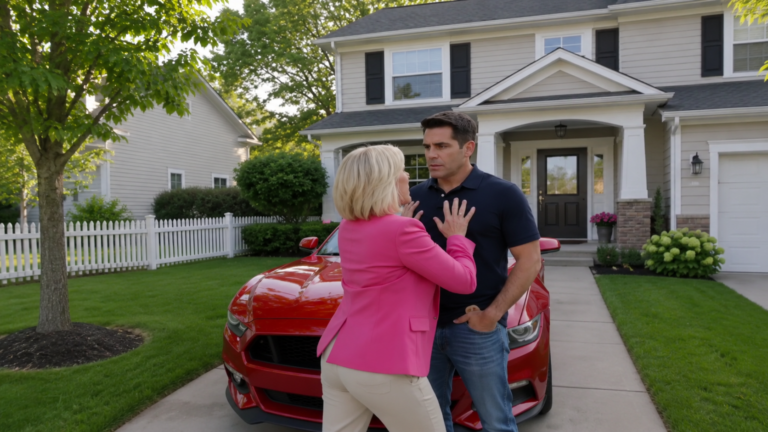
Celia, a tired-looking woman in her thirties, approached Mara. “I never meant your home to be used,” she said. “Simon said you had agreed to the outside photographs.”
“You brought a child into my yard.”
“I know. I accepted his explanation when I shouldn’t have.”
“Did you touch my service door?”
“No. I didn’t even know there was a service door.”
Mara studied her. Celia did not seem to be rehearsing lines. Her worry showed in the way she kept twisting the seam of her jacket between her fingers.
“Why are you still here?” Mara asked.
“Because these sets belong to a team of people. I want to stop him without punishing everyone who built them.”
They walked past a fake laundromat and entered the room displayed in the advertisements. The orange armchair stood beneath a slanted painting. The red wagon was beside the window, and the green raincoat hung from the back of a chair. Up close, the wagon’s paint was chipped. Its wheels were dusty from real pavement.
Mara picked up a card from the table. It held a photograph of a house identical to hers, followed by a question: WHOSE DOOR IS NOT LOCKED?
Celia went pale. “That wasn’t in the version we approved.”
A voice came from the room’s hidden speakers. “Celia, put down the cards.”
Everyone froze.
Simon Rusk stepped into the doorway. He was tall and neatly dressed, with a pleasant expression that had become inappropriate the instant he chose to keep wearing it. In one hand he held a small remote.
“This is an unfortunate misunderstanding,” he told Holt. “The show deals with boundaries. Some audiences find that uncomfortable.”
“It’s not a show tonight,” Holt said. “We need you to come with us and answer questions.”
Simon smiled. “Of course. But first, I’d appreciate it if nobody damaged the exhibit.”
He pressed the remote. The lights went out. A woman screamed. The sound of a door closing echoed through the warehouse, followed by a recorded child’s voice asking, “Where am I?”
Holt raised her flashlight and called for everyone to remain where they were. Mara stood still, counting the seconds. She understood then why Simon had insisted on the theatre of uncertainty. In darkness, with sound echoing from different corners, adults became susceptible to any voice that sounded authoritative.
A white line of light appeared beneath the far door. Simon had gone through it while people turned toward the speakers. Holt followed with another officer. Mara and Priya stayed beside Celia.
“The exit is this way,” Celia said, pointing toward the left corridor.
Priya shook her head. “That corridor wasn’t there when we entered.”
Celia looked again and swore softly. A movable wall had rolled into place, blocking the usual path. It was part of the show’s changing layout.