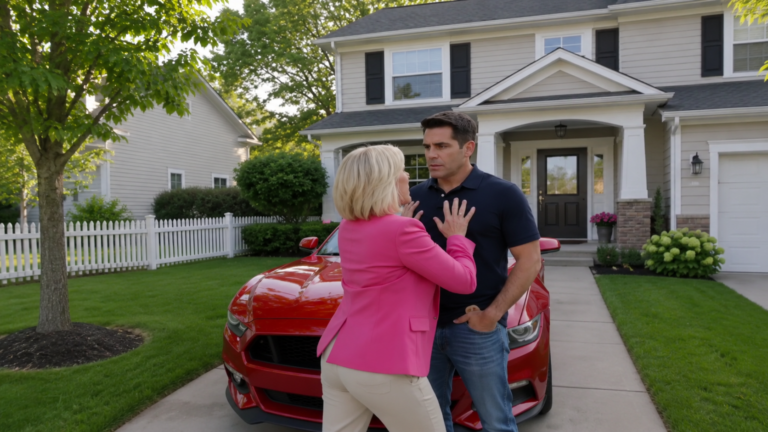
Nathan Fenwick arrived while the officers were finishing. He stayed on the public sidewalk, a young man with dark circles. “My grandmother asked me to tell you she’s going to pay for the window,” he said. “I know she scared you. She scared me too.”
Mara looked at him. “Did she really think somebody was following you?”
“She did. I showed her my delivery schedule and the picture Simon sent her. He took it from the hardware store’s public social page. It wasn’t proof of anything. But he knew exactly which fear would make her listen.”
Nathan glanced toward the house. “I was angry enough to shout at her last night. She didn’t argue. She said I had every right.”
“She’ll need time,” Mara said. “So will I.”
Nathan nodded. Neither made a promise about friendship or forgiveness. A police van pulled away, carrying the last of Simon’s equipment. For a moment the street was quiet enough to hear a sprinkler ticking two gardens over. Mara closed the gate and went back inside to sweep the final chips of glass from the baseboard.
Chapter Ten: What the Cameras Could Not Tell
Willa arrived at Priya’s apartment on Saturday morning with a cardboard box of pastries and an apology she had written by hand because she didn’t trust herself to say it without crying. She stood in the doorway until Mara invited her in.
“I damaged your home,” Willa began. “I frightened you. I should have called for help instead.”
Mara looked at her for a long moment. “Yes. You should have.”
Willa nodded, accepting the words without trying to soften them.
“Why did you think breaking my window would help?” Mara asked.
“Simon told me a stranger would come to your door. He said the stranger would be carrying a false alarm notice and that you wouldn’t look at your phone unless something happened. He said Owen was nearby and would suffer if you opened the wrong door. I thought I was putting a warning in your path.”
“Did you know the man at the front door was working with him?”
“Not until the police asked about the equipment. I thought he was someone Simon wanted to trick. I didn’t understand how many lies there were.”
Mara had expected an elaborate excuse. Instead she received a plain account of fear, gullibility, and the speed with which a person can lose judgment when given a story that puts someone else in danger.
“You could have knocked,” Mara said.
“I know. But Simon convinced me he would see it. He said you were being watched. I thought the only way to make you look was to break something. It was foolish. I am sorry.”