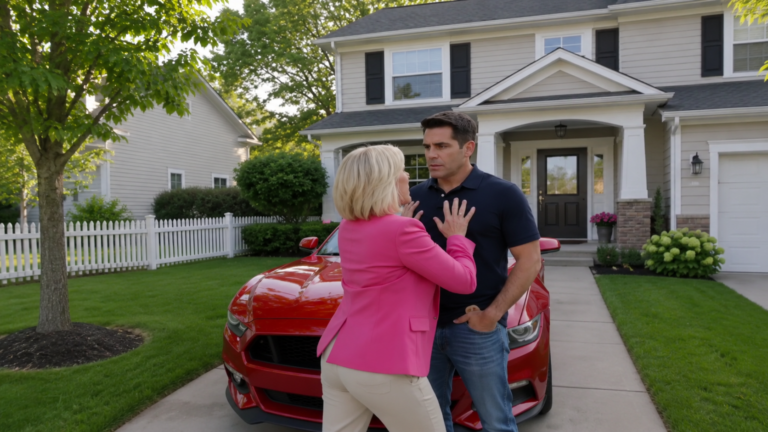
Chapter 67: Vivian at the Fence
Vivian approached me one afternoon while a contractor installed the replacement camera.
She carried a check for the damaged equipment and a written apology.
I accepted the check because she owed me the money.
I did not accept the idea that payment settled everything.
“I was afraid,” she said.
“You made other people afraid,” I answered.
She nodded.
“I know.”
“Claire was asking for help inside your house.”
“I know.”
“My father died without seeing his son come home.”
Vivian looked down at the checkbook in her hands.
“I can’t change that.”
“Neither can I.”
She walked back toward her property without asking me to forgive her.
For once, that was the right thing to do.
Chapter 68: The Camera in Its Place
The new camera was mounted above the garage on a stronger bracket.
Its view covered my driveway, gate, and front walkway without capturing Vivian’s windows.
The technician showed me how to export recordings and check the service’s privacy controls.
I thanked him and stepped back to see the device from the street.
Eli came outside carrying two mugs of coffee.
He looked up at the camera and smiled faintly.
“Dad would have bought three backups,” he said.
“He probably would have installed all three,” I answered.
Eli handed me a mug and leaned against the garage door.
The initials scratched into the paint had been repaired, but I kept a photograph of them in the case file.
They marked the moment someone tried to frighten me away from the truth.
Instead, they helped bring my brother home.
Chapter 69: The Ordinary Questions
Eli’s return brought questions our family had never imagined asking.
We needed to know whether his old identification documents remained valid, how he could recover employment records, and whether he wanted to use the name he had carried through his years away.
He asked to be called Eli at home, but he still signed his work applications Evan.
I wondered whether it was easier to keep a name that did not carry eleven years of missing-person posters.
He told me he wanted to decide slowly.
One afternoon, he found my father’s collection of handwritten repair manuals and sat on the garage floor reading them.
He laughed at the margins, where Dad had corrected the manufacturer’s instructions in angry blue pen.
Then he opened a page that described an engine fault and stopped laughing.
Our father had written a note addressed to him beside the diagram.
Eli, check the simplest thing first.
It was exactly the kind of advice Dad had offered whenever a problem seemed impossible.
Eli folded the book closed and carried it into the house.
He kept it beside his bed for weeks.
I had imagined that reunion would mean conversations that never ended.
Instead, our strongest moments often came when neither of us spoke.
We could sit across the room and work on separate things without someone checking whether we were being watched.
I learned that this quiet was not an absence of feeling.
It was a form of safety Eli had rarely possessed.