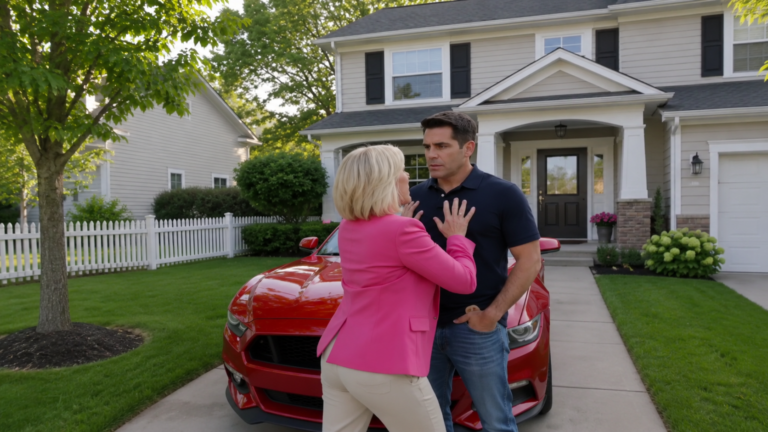
Chapter 10: The Quiet Truck
At 11:38 that night, a truck rolled through Wren Court with its lights off.
I saw it because I was still sitting in my darkened living room, unable to sleep.
The truck stopped beside Vivian’s garage.
A man climbed out and lifted a rolled carpet from the bed.
He was too far away for me to identify, but I could see his movements against the white siding.
He carried the carpet toward the side gate and disappeared.
I called Detective Vega and described what I saw.
She told me not to go outside.
A patrol car arrived within minutes, followed by another.
The truck accelerated down the street, but the first officer recorded its plate number.
The second officer entered Vivian’s property with her permission after she emerged from the house.
I watched the officers inspect the back gate and speak to her beside the garage.
When Vega arrived, she walked straight to the narrow side passage.
Then she looked upward at the empty camera mount across the driveway.
She crossed to my porch and asked a question that changed everything.
“Nora, does your camera subscription include a second-angle recording from the doorbell?”
I had forgotten about the older doorbell unit my father installed before he became ill.
It still worked, although its battery lasted only a few days.
I opened the app, selected the previous night’s archive, and found a clip that lasted nineteen seconds.
The truck had been there before.
It had arrived at 2:11 the morning the initials were scratched on my garage.
The driver stepped into the light as he opened the passenger door.
He was wearing my brother’s old blue baseball jacket.
And for one impossible second, he turned toward the doorbell camera with Eli’s face.
PART TWO: THE COST OF A FAMILIAR FACE
Chapter 11: A Face in a Poor Recording
I showed Vega the recording with my hands pressed flat against the kitchen table.
The man resembled Eli so closely that I felt the years since his disappearance collapse into a single breath.
He had the same long nose, the same uneven smile, and a small mark near his left eyebrow.
Vega enlarged the frame but refused to identify him from a compressed video.
“We need an independent comparison,” she said.
I wanted to argue that no comparison was necessary.
Instead, I remembered how many strangers had been mistaken for Eli during the first years of our search.
A man at a bus stop in Harrisburg had been photographed from behind.
A musician in Ohio had answered to the wrong name in a crowded bar.
A cashier in Delaware had been approached by my father and frightened badly enough to call the police.
Every mistake had cost us another piece of hope.
“The jacket is his,” I said.
Vega asked how I knew.
I told her about the white patch my father sewed over a tear on the left sleeve after Eli caught it on a fence.
She examined the image and found the patch.
“Someone may have kept his clothing,” she said.
“Or he may have kept it,” I answered.
Vega did not contradict me.
She asked for copies of every photograph I had from the summer he vanished.
I gave her the family album and watched her seal it in an evidence envelope.
When she left, I listened to the clip again without looking at the screen.
I heard the vehicle door close and a low voice say something beyond the microphone’s range.
Then came a second voice, quiet and unmistakably female.
“Don’t let Nora see.”