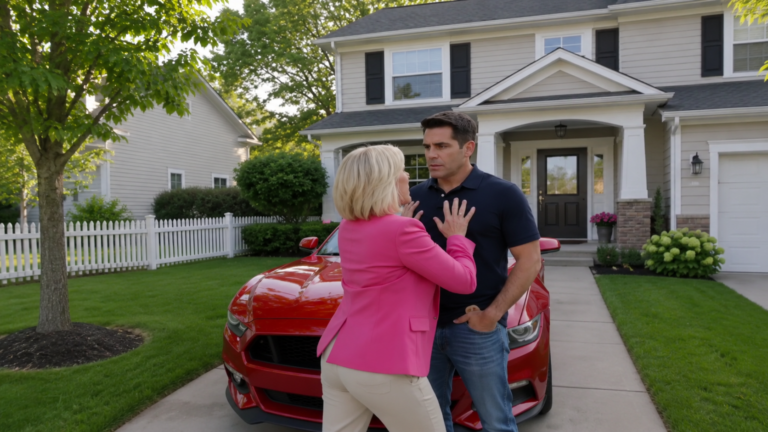
Chapter 12: The Woman Who Wanted the Camera Gone
Vivian called at seven the next morning.
Her voice was steady, but her breathing sounded shallow.
“You’ve had your entertainment,” she said.
“I want you to stop standing in the driveway.”
“Your visitor was there again last night.”
She said nothing.
“Who was he?”
“You’re making a serious mistake.”
“Did you know my brother?”
“Everybody knew your brother.”
“Did Malcolm know him?”
There was a faint click, as though Vivian had placed the receiver against a hard surface.
When she spoke again, her voice had changed.
“Your father should have left this alone.”
“My father died believing Eli was alive.”
“Then he was fortunate.”
The cruelty of those words stunned me.
Vivian continued before I could answer.
“He never learned what desperate people can persuade themselves to do.
”
I asked whether she was talking about herself.
She hung up.
I wrote down the conversation immediately and sent the notes to Vega.
An hour later, a neighbor named Patricia Ames knocked on my door carrying a package that had been left at her house by mistake.
Patricia was a retired librarian who lived two doors down and rarely repeated gossip unless she could name a source.
“I saw Vivian’s ladder yesterday,” she said.
“Everyone saw it.”
“I wasn’t asking about the ladder,” I told her.
She lowered the package onto my porch bench.
“I thought you should know that your father used to meet her at the park every month.”
“My father hated Vivian.”
“That may have been true, but he still met her.”
Patricia explained that she saw them several times near the abandoned bandstand,
usually at dawn.
“They never looked friendly,” she said.
“They looked like people negotiating something neither of them wanted discussed.”
Chapter 13: The Bandstand Envelope
The park’s bandstand stood near a shallow pond and had been closed to performances for years.
I walked there after lunch without telling anyone I expected to find something.
A fresh line of yellow paint marked a repair area on the steps, and a maintenance worker was clearing leaves from the benches.
He recognized my father’s name when I asked whether he remembered an older man visiting regularly.
“Mr. Mercer brought coffee and sat there every first Thursday,” he said.
“Sometimes he met a woman.”
“Vivian Rourke?”
“I never asked.”
The worker said my father once left a small envelope behind and returned in a panic to retrieve it.
He remembered because the envelope had a red square drawn on the front.
I thanked him and called Vega from the path.
She told me the detail was useful but reminded me not to interpret an unidentified envelope as proof of wrongdoing.
I agreed, although the map from my father’s storage box also contained a red square.
That afternoon, I laid the map across my kitchen table.
The square marked a utility shed near the old railway cutting.
Someone had written the number four inside it.
Another note in the margin contained only two names.
Vivian and Grace.
I knew no Grace connected to my brother.
By evening, I was searching old yearbooks for the name.