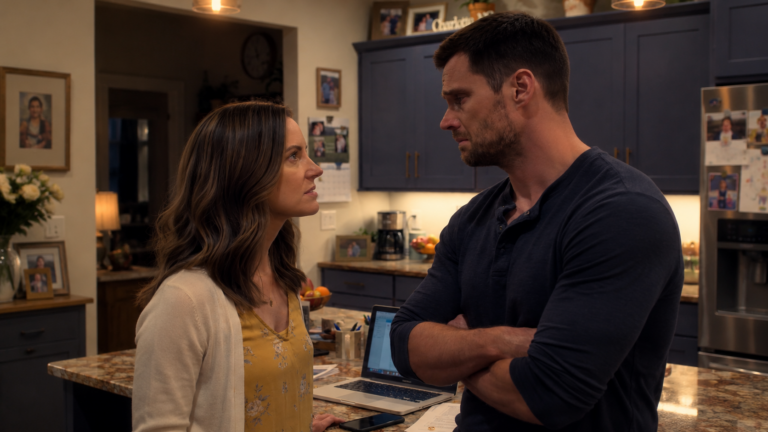
He already knew enough to make decisions about his own life.
Helen provided copies of messages Vanessa had preserved.
Several showed Daniel discussing the guarantee and urging Vanessa to keep Mark uninformed.
One message mentioned a payment to Bell Commercial Services.
Another referred to an older property document Daniel wanted to obtain.
Rachel asked whether Vanessa knew what document he meant.
Vanessa said Daniel had mentioned the service lane beside Mark’s shop.
She believed he wanted to use the lane as part of a proposed redevelopment project.
Mark stared at her.
Daniel had never asked him about selling the shop.
He had never asked permission to use the lane.
Yet he had been studying both while pretending to offer Vanessa a better future.
Rachel asked for the original messages and explained how they should be preserved.
The meeting ended without a dramatic confrontation.
Mark walked outside alone.
Vanessa followed him to the parking lot but stopped several feet away.
“Can we talk without lawyers someday?” she asked.
Mark looked at the empty space between them.
“Maybe,” he said.
“I need to know who I am when I am not protecting your secrets.”
Vanessa lowered her head.
He got into his car and drove away.
THE SERVICE LANE
The certified land records arrived the following week.
They confirmed that Mark’s father had acquired the full business property when the partnership dissolved.
They also confirmed a recorded easement allowing the shop to use the service lane for deliveries.
The easement remained valid under the recorded documents.
Rachel explained that no one could simply erase it by filing an ordinary private agreement.
She also explained that development proposals could create disputes over access even when ownership was clear.
Mark had no desire to become a property lawyer.
He only wanted to keep his business operating.
Nadia located a preliminary redevelopment presentation prepared for a group of private investors.
The presentation described a commercial complex that would replace several aging buildings near the highway.
Mark’s shop appeared on one of the maps.
The map treated his service lane as available access to a proposed loading area.
A small note described his property as a potential acquisition.
Mark read the phrase several times.
He had never agreed to sell.
The proposal was not a binding transaction, but it explained why someone might be interested in his land.
Rachel warned him that the proposal alone did not prove fraud.
She said the financial documents and the redevelopment materials had to be examined separately before their relationship could be established.
Mark accepted the distinction.
He had seen enough careless accusations to understand the damage they could cause.