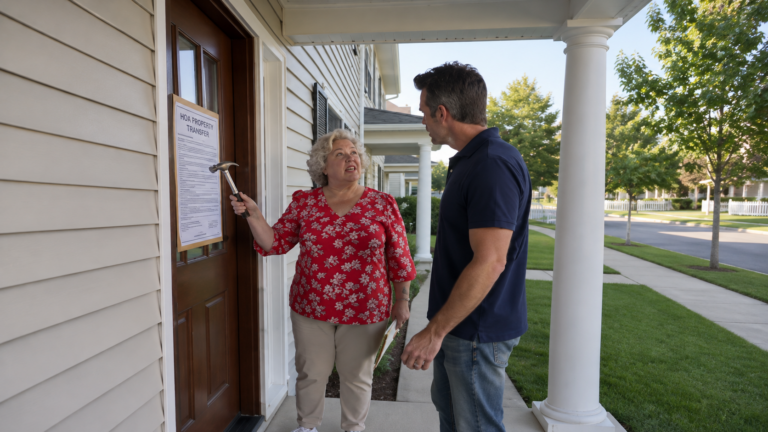
He asked Martin to preserve the original notebook and the email printouts.
Martin seemed relieved to be told not to hand them over immediately.
He had arrived fearing Walter would demand a public confession on the front steps.
Instead Walter called Nina, who asked Martin to come to her office and discuss the material’s handling.
Before leaving, Martin hesitated near the door.
“There were two accounts,” he said.
“One for dues, one for the corridor project.”
“Who controlled the second?” Walter asked.
“Brenda and Leonard.”
“Was it an association account?”
“That’s what Brenda told us.”
Martin stared at the marigolds growing beside the porch.
“I don’t know whether that’s true anymore.”
Later that day Walter visited the public bank records available through the association’s annual filings.
The registered account belonged to Cedar Glen Neighborhood Association.
The payment receipts Evelyn and the others had kept named Glenway Community Holdings.
Walter copied the names exactly, including the punctuation.
He did not infer that the two organizations were the same.
He called Nina and reported the discrepancy.
She advised him to avoid contacting the banks directly about another person’s private accounts.
Instead she would request the association’s financial records through its governing process and evaluate other lawful disclosure options.
Walter put the documents in a labeled folder.
For the first time he stopped calling it Brenda’s case.
There were six households, an association board, a developer, and multiple organizations with overlapping names.
Brenda was central, but the system mattered because it had given her claims an appearance of legitimacy.
A person who trusted the official-looking stationery might never ask who actually received a payment.
Lorraine had once said that a badly organized library could hide a book more effectively than a locked cabinet.
Walter thought of that remark as he labeled the files.
He could no longer ask his wife what she thought about Brenda.
He could, however, honor the way she had taught him to distinguish between a title and the actual content beneath it.
The boundary surveyor arrived in a dusty pickup with a tripod, a digital receiver, and a habit of checking every measurement twice.
Her name was Caroline Ames, and she had worked throughout the county since before Cedar Glen’s newer houses were built.
Walter hired her to review his lot because he wanted an independent professional opinion.
The other property owners chose whether to commission related work on their own parcels.