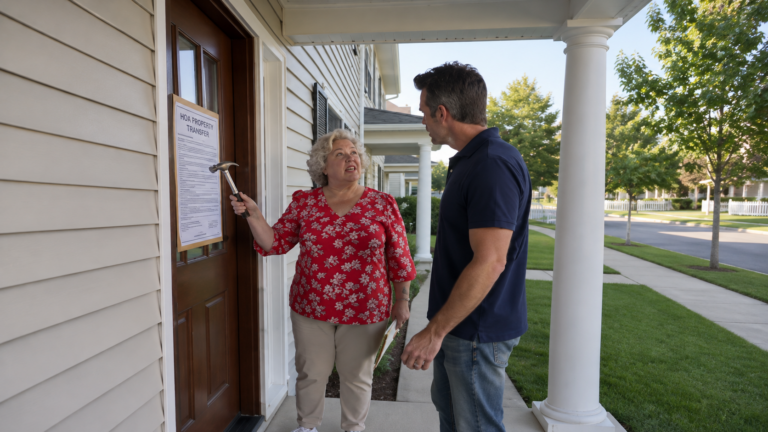
“Someone decided an official stamp would frighten us into agreeing,” she said.
Walter nodded slowly.
“Then we’ll find out what the stamp actually confirms.”
As they crossed the parking lot, a man in a gray jacket approached.
He introduced himself as Leonard Marsh, a document preparer who sometimes worked for Glenway Community Holdings.
Walter recognized the initials.
Leonard said he had heard that the neighbors were asking questions and wanted to clear up a misunderstanding before lawyers became involved.
Evelyn asked why the association had not approached them openly.
Leonard replied that the filings were routine updates necessary for stormwater compliance.
Sofia asked which county rule required them.
He said he could not remember the ordinance number.
Walter asked who paid Leonard to prepare the deeds.
Leonard looked at the courthouse doors.
“I’m trying to save everyone trouble,” he said.
“Then answer the question,” Sofia replied.
Leonard handed Walter a business card and walked away.
The card contained a name, a phone number, and an office suite.
It did not mention Glenway.
Walter waited until Leonard was out of earshot before writing down the conversation.
He had no recording and would not pretend otherwise.
He did have two witnesses who heard the same evasions.
The little mystery of the flowerbed was becoming a matter of records, representation, and money.
None of those things could be resolved by shouting louder than Brenda.
Walter went home and watered the marigolds.
The vacancy at the end of Cedar Glen was not truly vacant.
A roofless concrete foundation lay beneath the weeds, and a cracked loading platform faced the creek.
Walter remembered trucks visiting the lot years ago when Bellamy Development used it to store pipe sections.
The development company dissolved after a financial dispute, leaving the land in the hands of a separate investor.
Walter found that name through the county tax assessor’s map.
The current owner was Harrow Ridge Partners, a company registered outside Georgia.
A recent zoning application proposed a secure storage and delivery facility on the old lot.
The application required reliable vehicle access from the south because the existing road crossed a flood-prone low bridge.
Cedar Glen’s original street did not provide legal commercial access to that land.
The proposed route followed the exact green corridor shown on Brenda’s laminated map.
Walter printed the application and laid it beside the recorded instruments.
If the six easements were enforceable as written, they could be used to argue that a service corridor existed across the homeowners’ frontage.