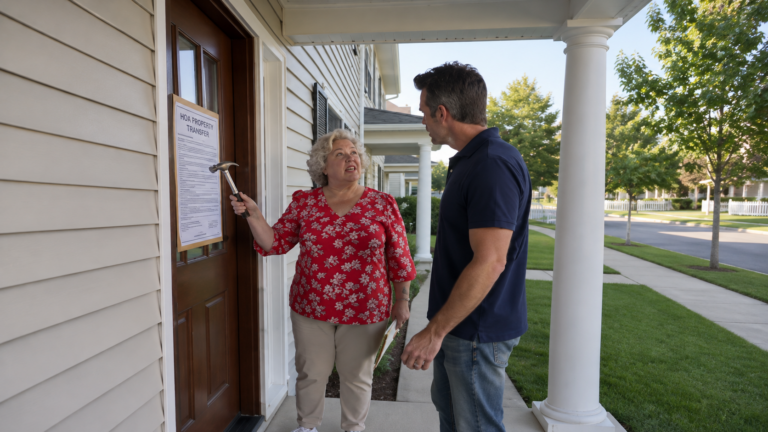
Walter said he could not read Brenda’s thoughts.
He could describe her actions and the consequences people were experiencing.
Nina recommended a temporary agreement that would require advance notice and explicit permission before nonemergency work entered any contested yard.
The contractor accepted that condition while the land issue remained unresolved.
Miriam placed a small sign near the tree identifying her property boundary without threatening anyone.
Walter watered the marigolds that evening and noticed a stranger slowing his car to photograph the porch.
The driver might have been interested in the neighborhood controversy.
Walter made a note of the time rather than assuming every passing vehicle was part of a conspiracy.
His fear had become sharper, but he did not want it to swallow his ordinary judgment.
He was still a retired man with a garden and a sore knee.
He had to remember that his life contained more than the dispute.
He called his grandson in Savannah and asked about school.
The boy described a science fair project that had gone wrong in a spectacular way.
Walter laughed hard enough to forget the corridor for several minutes.
After hanging up, he looked across the street at Brenda’s dark windows.
He wondered whether she had anybody with whom she could talk about something that was not Cedar Glen.
The thought did not excuse what she had done.
It reminded him that a person could have every practical reason to abandon a harmful course and still keep going because she no longer knew who she would be without it.
The county planning review took place in a room with fluorescent lighting, a clock that ran slightly fast, and chairs that scraped loudly against the tile.
Walter arrived early enough to find a seat near the side aisle.
Evelyn brought a folder of her documents and a small bottle of water.
Sofia had come directly from an overnight shift and wore her hospital badge clipped to her coat.
Celeste Rowan sat with the developer’s engineer and legal counsel.
Brenda occupied the front row with Leonard’s former assistant, who avoided looking at the homeowners.
The planning officer explained that the hearing concerned a proposed use, not a final adjudication of private land rights.
He allowed public comments about traffic, drainage, safety, and the accuracy of the submitted materials.
Brenda spoke first.
She described the corridor as a community improvement that would reduce flooding and create jobs.
She said the association supported the plan and that a small number of owners had raised questions about paperwork.