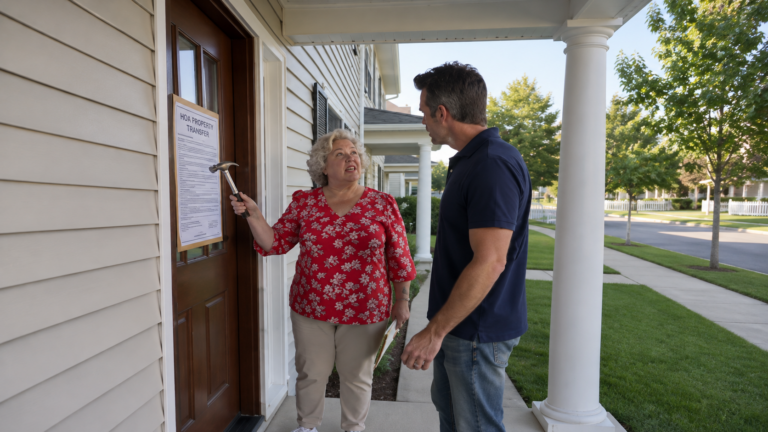
The group did not applaud.
A promise to seek instructions was not a completed agreement.
After the meeting Celeste asked Walter why he seemed particularly angry about the yellow flowers.
“They aren’t valuable,” she said carefully.
“I mean financially.”
Walter told her about Lorraine and the mornings they used to spend planting along the porch.
He described the first spring after her death, when he put six seedlings in the wrong places and had to start again.
Celeste listened without interruption.
“Then they are valuable,” she said.
Walter nodded.
“They’re also mine to decide about.”
Celeste looked toward the empty development lot.
She said she had grown up in a town where a factory closing erased hundreds of jobs, and she believed new industry could help communities survive.
Walter did not disagree with the general point.
He asked why the benefits of the project required neighbors to sign rights they had never chosen to grant.
Celeste did not answer immediately.
“I don’t think they should,” she said at last.
Walter respected the answer because it admitted a problem without pretending to solve it.
Two days later Harrow Ridge announced a voluntary pause in its access negotiations pending review of the records.
The company did not withdraw the entire development application.
Brenda’s newsletter presented the pause as a temporary concession to politically motivated obstruction.
Celeste declined to endorse that description.
Walter began to understand how competing organizations could keep a dispute alive even after their practical interests diverged.
The developer wanted a usable route and a profitable project.
Brenda wanted to preserve the authority she had claimed over the neighborhood.
Those interests had overlapped when nobody questioned the documents.
They might not remain aligned once the documents became liabilities.
Brenda’s daughter, Allison, came to Walter’s door on a rainy Tuesday evening.
She was in her thirties, with dark hair tied behind her head and a habit of choosing every word carefully.
Walter had seen her at holiday gatherings but knew little about her life outside the neighborhood.
She apologized for coming unannounced.
“I don’t want to defend my mother,” she said.
“I need to know what she actually did.”
Walter invited her onto the covered porch, where they could speak without entering the house.
He explained that the six homeowners disputed the grants and that the filing process was under review.
He did not show her confidential correspondence or claim that Brenda had been charged with a crime.